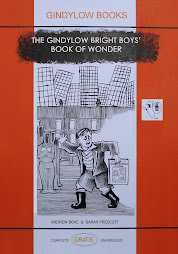
Retro Sci-Fi or just behind the times? Who can tell, not me. I prefer stories about Upper Sixth gels at boarding school with crushes on the Head girl and the Head Gardener respectively, who find themselves struggling with their burgeoning womanhood.... But perhaps the less said about that - especially with Mrs T. around - the better! My own preferred reading aside, I bring you the second and final part of Mr Lewis' comic (so he tells me) time-travelling story. It's not bad I suppose, but not a boarding school gel in sight!
Timeless Trevor T.Proprietor and lover of saucy literature and not ashamed of it by gad!
The story so far: Leonard Skrane, scientific genius and budding science-fiction author, gate-crashes the virtual sixth annual Big Brains of Sci-Fi convention, (remotely thanks to the virtual-reality relay, the numbskull - or braindrayne, depending on your financial position) to bring all those present the startling news that he has not only invented a form of time-travel, but has used it to inadvertently tamper with the past. If he hadn't the delegates and audience would have remembered that Albert Gore, a young man from the East End of London, circa 1888, was the Biggest Brain of Sci-Fi ever. The delegates and audience have no memory of the name Albert Gore, and so, Skrane proceeds to tell them how the biggest brain in Sci-Fi ever, was accidentally erased from their memories ...

by Mark Lewis
Part 2 - Tomorrow Yesterday
2.
It was a Sunday evening in the autumn of 1887 when I arrived in
As well as the fog, I had also expected to find the street full of the kinds of colourful characters you see on the Numb; prostitutes and barrel-organ grinders, shoeless street-urchins and old lady flower-sellers; but instead the street was practically deserted. A few Hansom-cabs jingled over the cobbles, a few moustachioed gents in their best but still shabby suits sauntered past, no doubt on their way to the pub; but that was the sum total of human traffic on that clear, September evening. No one noticed me as I walked along in search of Gore and sons master butchers, and as I strolled nonchalantly along the pavement, I congratulated myself on the effectiveness of my disguise.
Gore and Sons stood at the furthest end of the street. On one side of the shop stood a cobbler’s and on the other, a second-hand clothing store. All three shops were rather poor and mean-looking but far from disreputable.
The windows of the shop were darkened and the shop door was bolted, but as I pressed my nose up against the glass, I could see a faint glow of light coming from inside. Someone at least was home. I looked around me carefully, and seeing that the street was empty once again, I walked through the locked door and into the empty shop.
Perhaps at this juncture I ought to explain the basic principles of my time-travel device.
As many of you are no doubt aware, since Einstein’s theories of special and general relativity were published, physicists such as Hawking, Firmi and Pod have been arguing the impossibility of time-travel.
Whilst it has long been thought possible that, thanks principally to the phenomenon of time dilation, a person travelling faster than the speed of light might travel to what we might perceive as the future; no one has yet come up with a satisfactory theory to answer the question of how to travel backwards in time.
However, to go back to the theory of time dilation, as you know the theory states that during this phenomenon, external time slows down to the observer who is travelling faster than the speed of light, whereas their own local time continues at a constant rate. Therefore, when the observer arrives at their destination, only days may have elapsed for them, whereas back on their own planet, far, far away by now, time may have moved on a thousand-fold. But, in Einstein’s Special Theory of Relativity, time dilation is reciprocal, so that an observer standing at the same point of the time-traveller’s departure, looking at the time-traveller’s destination, would see only an image of a long dead past.
Giving this theory a practical basis, I began to wonder if it were then possible to project an image back through to the past from that future point? After all, the light that reaches us from the stars is already aeons old by the time our eyes perceive it. What if, using a vehicle travelling faster than the sped of light, I could place a device in the far future that could project an image of myself back to the Earth of the distant past, couldn’t it then go where my body couldn’t; back in time to the London of Albert Gore?
So I began to work on this idea of mine, using a far more complicated version of the basic theory I have just outlined. And, adapting current Nubskull technology, I experimented and refined a technique whereby I could send a projection of myself from a relay placed in the far distant future, (sent there on board one of the new automated faster than light freighters supplied by my dear friend, space-shipping magnate Zu-Zu Sarthrust). This relay would also allow me to receive an image from the past and assimilate enough visual data to simulate a sensory impression of my surroundings.
And that eventually, was how a projection of my self was able to walk through the solid, wood and glass door of Gore and Sons, with all the ease and stealth of a prowling ghost.

Entering the shop, I noticed that the light was coming from a back room. I moved swiftly past the empty counters, and the meat-hooks, toward the source of the light.
Around me, the tin trays that on workdays would be filled with meat, and the white wall-tiles, glistened eerily in the creeping gloom. Beyond the shop, there was another room filled with scarred benches and big wooden meat-lockers that were stained with blood, and then finally a heavy wooden door, topped by a pebbled window that led to the shop’s back parlour. And it was from here that the light was shining.
Once again I floated through the door with ease.
The Gore’s back-parlour was neat and snug. The floorboards were painted brown and dotted with rag-woven rugs. Solid, heavy furniture and dark framed photographs gave the room a feeling of gloom and oppression, as if making a statement that this was owned by serious, sober people.
It was now dusk outside, but inside the small parlour I had the impression that it would always be dusk there, no matter what time of day elsewhere.
Besides the dark, oppressive furniture, the room had very little ornament: a few improving texts; a thick, leather-bound family bible; some fire-irons and a large fire-place, its coals weakly smouldering; a brass oil lamp with a frosted globe. And then of course there was the occupant.
At a small polished dining table beneath the lace-curtained window, sat a young man in his late teens. He was a sturdy, round-faced youth, with wispy, flaxen hair that would be gone by his mid-twenties and a florid complexion that they would have called choleric in the Middle-Ages. And yet for all his angry colour, the youth looked mild and placid. His only real feature of note was his slightly protruding lip, which added a slight aspect of idiocy to his otherwise plain appearance. He was respectably dressed in the style of the times, shirt and waistcoat, heavy black trousers; the only concessions to the informality of the room was that he had removed his starched collar and donned a pair of carpet-slippers.
In front of him was a card-backed ledger, the sort that the shop accounts would usually have been kept in. The pages were thinly ruled and divided into columns by heavy blue lines. But the young man was not keeping his accounts. Instead, in the precise handwriting instilled in him by the parish elementary school, he was hurriedly, almost feverishly inscribing sentences and paragraphs that spilled over the ruled columns and rushed down the page like a river that had burst its dam. This was the man I had travelled two hundred years to meet. This was Alfred Gore the Biggest Brain of Sc-Fi.
I stood and watched him at work, feeling understandably awed by the experience of being so close to genius. On his part, Gore was so engrossed in his writing that he completely failed to notice me. His eyes were rapt, and I noticed that as he wrote the tip of his tongue protruded slightly from the corner of his mouth.

For a while there was only the sound of his pen, scratching across the page, alternating with the tap of his pen in the ink-well, and a slight, adenoidal whistling coming from his nostrils. I crept closer, trying to peer over his shoulder at what he was writing. I wondered if it was The Metal Bird Menace or perhaps Upwards to the New Babel, both of which were known to have been written in the late 1880’s. I had no chance to find out for as I drew closer, as if through some sixth sense, Gore suddenly shivered and turned round.
To say he was astonished is an understatement. Catching sight of me, Gore suddenly turned pale. His pendulous lip fell and began to quiver. His pupils dilated to the size of dinner plates; and he jumped in such a violent manner that he upset his chair and knocked the table, almost spilling the ink-well over his ledger in the process.
For a moment he was rigidly silent as if all the air were being squeezed from his throat; and then after what seemed an hour, he finally managed to ungrammatically stammer: “A .. a apparition!”
I felt embarrassed. I had meant to announce myself more properly, rather than be caught sneaking a glance over the genius’ shoulder. But nevertheless I gathered myself together and did my best to explain:
“In a way Mr Gore, I am indeed an apparition as I have no real, corporeal form. However if I am an apparition, it is one of science rather than the supernatural.”
This didn’t seem to help. Gore still looked terrified and there seemed to be tears welling at the corners of his eyes. He clutched at his chest with one chubby hand and for a moment I thought he were about to have a heart-attack. Luckily for both history and myself, he wasn’t.
“W … what do you mean, ‘an apparition of science’?”
“I mean that I am able to visit you through the intervention of a mechanical device. I have in short come from the future to ask you to help me prevent the terrible things I have seen. Only you with your big brain can help.”
This didn’t have much of a calming effect. Instead, Gore began to sway, and if it hadn’t been for the table behind him, propping him up, he would have ended up a crumpled heap on the floor.
I tried a different angle of attack.
“I come from the future. A future where you are worshipped and adored as one of the Biggest Brains in Sci-fi. A future where your great literary works have made you almost as famous as Shakespeare.”
He blinked at me with his – it must be said – rather stupid, bovine eyes.
“Famouser than Shakespeare? But I’ve only had one story published: ‘The Underground War’.” He spluttered with amazement. “ - in the Reverend Crisparkle’s Good News and Ill Omens. I don’t think it has that much of a circulation beyond Hampton Wick”
“Believe me maestro, your fame has come to pass in the future of which I am part.”
But Gore was still not convinced, and it took a further hour before he finally began to realise that he was not being visited by spirits from the grave; or a product of a combination of brain-fever and the worry over some loose change he had purloined from his father’s overcoat pocket.
Finally, as we heard the sound of his parents in the back yard, arguing bitterly as they returned from a visit to relatives, Gore hurried me upstairs.
“We better talk in my room,” his hissed urgently, “I can’t begin to think what Ma and Pa ‘ud make of you.”
So I followed him up the dark and rickety stairs, to his dark and rickety back bedroom. I cannot say I was impressed. It looked more fitted for a meat locker.
“So how exactly can I ‘elp Mr Skrane? Though I hardly believe I can help.” He was still whispering as the angry shouting went on, muffled, but still audible, below.
“Mr Gore, your stories will offer the most exciting and plausible visions of the future for over a century and a half. And then, even more remarkably they will cease to be merely plausible but in fact frighteningly prescient as well …”
His eyes lit up, but not for the reason I’d first imagined.
“Prescient, that’s a good word. Let me write that down. What’s that mean exactly?”
I explained with a sigh as he scribbled it down on a celluloid cuff that had been sitting on a shelf above his tiny bed.
In some respects, this had turned out to be a disappointing meeting. Perhaps I should have tried the older, and definitely more learned Gore of ten years in the future. And yet, would the older man rather than the impressionable youth have listened to me? I doubted it and so persevered.
“To put it plainly,” I explained, “people will think you saw the future in some almost magical or mystical way. But the worst thing about your gifts of prophecy is not that they will come true but that people will make them come true. You will show people what terrible things they will be able to do with technology, and they will act upon them. Don’t misunderstand me, it won’t be your stories alone. Artists, philosophers, clergymen, poets and scientists, but mostly the film-makers will translate your stories into essays, paintings, poems, machinery and films that will make your nightmare vision look, well, ravishing, desirable – ahem – sexy even.”
Gore flinched at the word ‘sexy’, but he understood all the same.
“These great thinkers and artists won’t do it to arouse society, to whet its appetite if you will. Like you they will act out of a sense of duty. Unfortunately they will be the only ones who understand. The rest of humanity will only get excited and see concrete and neon, high-rise buildings, killer robots and interstellar warfare desirable or fun (here I had to explain the concepts). But be assured, it is human nature that is at fault maestro, not you your-self.”

There was a moment or two of silence, punctuated only by the bitter argument still going on downstairs. And then Gore spoke again in tones of awe.
“But what can I do about it short of stopping writing now? Which I must say I’ve half a mind to do; not write another bleeding line, if you’ll excuse the profanity.”
“No, no, no maestro. That would be more terrible than a world where your stories come true. You must continue to write, it is your duty.”
“But what about all this prescience business, I can’t change human nature, so the word ‘ull all come out the same anyhow if I keep on writin’.”
“Not if you change the emphasis of your stories maestro. Not if instead of writing about a robot that maims and destroys, write about one that nurtures and frees a man from back-breaking, soul-destroying chores so that he might teach his children to love, not destroy their world.”
It was a heart-felt and impassioned plea, and I think a very successful one.
Gore looked like a new man. His eyes shone and the weak, fleshy curves of his face and body seemed to harden and take on a new aspect of determination. Even his pendulous lower lip seemed to be drooping a little less.
Yes my mission had succeeded. We spoke a little more and then, as the hour was growing late, I bid the Biggest Brain of Sci-fi a fond farewell and slipped away from 19th Century England, happy in the knowledge that at last I had helped humanity a little further up the evolutionary ladder, away from its violent and recidivist past.
3.
The entire, virtual audience and delegates of the 16th Conference of the Biggest Brains of Sci-Fi sat in stunned silence. Skrane looked around him at the millions of amazed virtual-faces and all their mouths hanging wide open, and felt ashamed.
“Imagine my surprise when I returned to find the world in an even sorrier state than the one in which I had left it. As I looked around me at the high-rise city tenements and people, pushed by killer robots falling from the high-rise tenements, I am not ashamed to say I wept. Not only had my plan failed but it was even possible after my meddling with time, that I was partly responsible for the terrible state the world was in!

But what had gone wrong? The answer soon came to me as I dialled up the complete works of Albert Gore on my numbskull. There wasn’t one, not a solitary story, not a single reference except, perhaps an obscure one that might have occurred to one or two of you when I first introduced his name this afternoon.”
A few dozen of the virtual mouths closed as recognition dissolved their earlier stupefaction. They were beginning to get the picture.
“Yes, Albert Gore and his goody two-shoes stories had completely failed, and consequently the outlet of creativity having been bunged up, so to speak, poor Albert became a beast himself.
That’s right ladies and gentlemen, the only mention I found of poor Albert Gore the butcher, was in connection with a list of possible suspects for the notorious Whitechapel murders of the late 19th century. Once they were known by a different name, but now ladies and gentlemen, thanks to my intervention, you will know them properly as the crimes of Bert the Butcher!”

The End