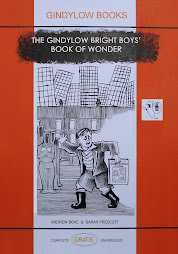
So here it is in it's entirety,The Gindylow Bright Boy's Book of Wonder. Soon I hope to post a PDF of the actual magazine as it was created by the authors so that you can, if nowhere near Leeds (which is probably quite the best position to be in) download and create your very own literary classic - all you will need is staples ... and paper ... and of course a colour printer.
Toodle-pip for now,
Trevor Tweedthwack, aka Nowhere Man, the co-boss of this outfit.
THE GINDYLOW BRIGHT BOYS’ BOOK OF WONDER
by ANDREW BOVE & SARAH PRESCOTT
Part 1
William’s Visit
From my office window I saw the campus gradually erased; the familiar landscape of high-rise apartments and crane derricks slowly yielding to a white page of mist. Immediately below; umbrellas bloomed like brightly coloured mushrooms on the rain-slicked street as people hurried past. It was a typically rotten August morning.
Grateful for the warmth of my tea, even though the brief, chilly shudder I had felt when I looked out of the window was nothing more than my imagination, I turned back to my desk. There was a sharp ratt-a-tatt on the door, and before I had time to say ‘come in’, William Clough, one of the library’s senior shelvers, shuffled into the room.
I had hardly ever exchanged more than three words with William in all the time I’d worked in the library, let alone invited him into my office; and yet there he stood, hovering nervously and looking up at me from beneath a pair of bushy eyebrows and a mop of silver hair. He had a strange, childlike quality exaggerated by his usual uniform of frayed knitted tank top, faded grey shirt and trousers, an over large head and big watery blue eyes that he usually hid behind a pair of thick black specs.
William always seemed nervous, hopping from foot to foot when standing still or biting a thumbnail when on the move. He walked with an unconscious swing of the hips and spoke in a reedy, high-pitched voice that was made all the more fussy by his slightly refined version of the Yorkshire accent. Along with his 1950’s schoolboy short-back-and-sides, his boyish clothes and manner, he seemed like a child who hadn’t realised that he had grown up and that the better part of his life was already over.
I looked at him in dumbfounded silence. What could he want? I’d never even seen him on this floor before. Presumably he’d come into the wrong office or was looking for my Line Manager, or something. For a moment he stood in silence just looking at me, but before I could ask him his reason for visiting, he spoke.
“I-I’ve seen you in the staff-room writing in your notebook.”
This was odd, to say the least. For a start I didn’t know that William could actually talk of his own volition; he only ever seemed to respond to direct questions, and his statement didn’t seem to have any relevance to our very separate daily existence.
3 “Is it true that you’re a Writer?”
“Well, I…I’m just an amateur…” I stammered; shocked by what seemed such a personal and intrusive question.
“But you do write?” He asked. “Stories, that sort of thing?”
“Well, I suppose. I’m more of a graphic artist than a writer is. I draw and write, well, what you’d call comics really – fanzines they’re called…” I trailed off. Why did he want to know, and what on Earth had it to do with him?
“That’s fine, I was awfully fond of comics in my day.” He continued, growing bolder, and most definitely stranger.
“In fact, you might say that fondness got me into the mess I’m in today.”
It occurred to me that he might be having some sort of a breakdown, which made me feel even more nervous. I began to wonder if I ought to call security, but I just stood there with the same cringing feeling I got whenever tramps ask me for money.
William continued, speaking quickly now: “I need to tell my story you see, because, well, I’ve got such an amazing story to tell. And I need someone to help me.
“I won’t be here much longer and I have to find the journal before I go. Someone out there might just have a copy of the Bright Boy’s Book of Wonder, and your story might jog their memory.
“Besides, I’m sick of carrying this around with me. It’s been very lonely…”
Just then the door flung open and my manager swept in, gawking openly at William. William ignored her, winked at me, since we now seemed to share a secret; and then, without a word, shuffled out of the room.
Margaret stared at me “I didn’t know he was allowed out of the basement”, annoyance more in her voice than humour.
“I think he wanted some stationary.” I answered feebly.
“Ack. Smells funny in here” she said, opening a window.
I blushed and stared at my screen, realising that, in spite of my embarrassment and nervousness, I was very intrigued about William's story.
I next saw William in the staff room a couple of days later. The weather outside was much the same, although it seemed that even more of the mist had eaten away at the city until only a few of the Victorian hospital buildings were left amidst the strange blankness; as if time was being turned backwards.
I was sitting sketching in my notebook, oblivious to everything else, when suddenly I looked up to meet William’s watery blue gaze.
“You look like a natural.” He grinned, awkwardly and plonked himself into the seat next to me, without being invited.
“Well. Since it’s only you and me, I –I could tell my story, if you like.”
I had the familiar feeling of annoyed embarrassment, but really, I wanted to hear what he had to say. Of course it would be some kind of deluded nonsense, nothing more than a product of his breakdown; but on the other hand, it might be useful material for a story…
“Go on then,” I said, plastering what I hoped was a friendly smile across my face. “What’s this amazing story?”
For a moment, William stared at me and then his whole body went limp and he slumped heavily in his chair, letting out a huge sigh.
“You won’t believe me, but I’m sick of carrying this around with me all these years.” He paused as if choosing his words carefully, but just as likely he was trying dramatic effect. He sighed, again for effect, and then…
“You wouldn’t believe it just to look at me; but you are sitting next to a real, genuine, bona fide time-traveller!”
I think I must have shrieked; I’d never heard anything so mad in my life, and told him so.
“Maybe not,” he answered huffily, clearly offended. “But listen anyway. You might just be surprised.”
I did listen and I was more surprised than I have ever been in all my life.
Part 2 - Billy’s Story
Billy hugged the book to his heart as he carried it up to his bedroom. He had run all the way from the tobacconists with it and was out of breath as he flopped onto his bed. It was a bright day outside, and the cries of children playing in the alley were carried through his window on the stiff breeze that sent his mum’s washing flapping in the yard, but Billy wasn’t tempted to join them. He’d been waiting for the book all year and now, finally, it was his.
He held it out reverently and looked at it from every angle, inspecting it closely for signs of wear and tear, but there were none, the book was perfect. He ran his fingers across the cover, feeling the embossed curves of the lettering. ‘The Gindylow Bright Boy’s Book of Wonder’, it read.
5 The book was a compendium of a boy’s paper, which was put out by a Bradford publishing house, Gindylow Books. Every two weeks, ‘The Gindylow Bright Boy’s Book of Wonder’, would print a variety of factual articles and interviews on topics that the Editor thought might be of interest to boys. So, alongside interviews with famous sportsmen and soldiers, there were cross-sections of jet-fighters and ocean-liners, stories of famous battles and the Wild West; but perhaps most importantly of all, there were instructions for constructing your very own engineering marvel.
‘The Gindylow Bright Boy’s Book of Wonder’ it was called, and wonderful, it looked. The title’s gold lettering curling and sweeping majestically over a red-cloth binding and in the centre of the cover, a shiny illustration of a Bright Boy: a young man with dark brown hair, dressed in tank-top and shirt, and rather more unconventionally, a pair of headphones. The headphones trailed from what looked like a homemade wireless-set that was bristling with valves and coils of wire. Unlike a wireless, the machine projected a swirling ball of energy whose centre formed the image of a futuristic city. Beneath the soaring buildings and roads that twisted and wove through the clouds, two of its citizens stood; a handsome man and a beautiful woman both dressed in strange, flowing clothes.
For a moment, staring in adoration at the book, he almost saw his own face, merging into that of the boy on the cover.
Billy stared at the boy for a good five minutes before carefully opening the cover.
Now for the contents:
First there was an illustration of the proposed Black Knight Rocket, which the caption said would one day carry the first Britons into space; then alongside it the contents list itself. He ran a finger down the list: Editor’s Letter; A day in the Life of a Marine; The story of the Battle of Thermopylae; An interview with Lord Mountbatten …he skimmed such commonplace fare until his finger came to the section he most desired, Science and Wonder: How to Listen to Spirits from the Other World; How to build a Thought Transference Machine; Build your own Jet-Pack and (here his heart missed a beat) How to Build your own Time-Machine. He’d been obsessed with this since he first saw the advert in last month’s edition. He flicked through the book, fingers trembling with anticipation, and finding the page he wanted, he began to devour the words with half-starved eyes.
And then it was teatime. His Mum’s voice called shrilly from the back parlour, sending him thundering down the stairs and into the kitchen to wash his hands. Then, after the usual scolding from Mum, he scraped his chair and himself up to the table where Dad sat reading the evening paper.
Mr Clough, a long, lean man with sad eyes and the sallow skin that hinted of a distant, foreign heritage, was a barber at Arthur Fountains’ on Royal Park Road. He always smelt of a mixture of gentlemen’s pomade, eau-de-Cologne and methylated spirits and was the only quiet, uncomplaining figure in Billy’s life.
As Billy sat waiting for his tea, his Dad tipped him a wink over the top of the paper and then went back to reading the sports’ news as his Mum carried the tea in. They ate in silence. After a sharp admonishment from Mum, Dad dropped his paper to his lap and then stared at his plate as he ate, a picture of weary resignation.
Mum cleared the plates away after tea, and there was a brief lull where Billy and his Dad were alone. Billy carefully studied the closed kitchen door, and reassured by the noises of scraping coming from behind it, he pounced on his Dad and began asking lots of complicated questions about valves and wire gauges.
His Dad smiled wearily and shook his glistening, brilliantined head.
“It’s no good asking me, lad. You know as well as I do, the one to ask about such things is Granddad West. It were him bought your subscription, after all.”
Billy sighed, his Dad was right. Granddad West, his Mum’s Dad, owned a wireless repair shop up on Hyde Park Road and was interested in all things electrical or technical. He had always wanted a son to take over the business when he retired, and not having had one, had transferred that expectation to his grandson. But Billy knew in his heart that he wanted to be something more exciting than the owner of an electrical shop: an Explorer, a Space Pilot, or, thanks to the Gindylow Bright Boys’ Book, a Time Traveller.
There was nothing else for it, in spite of his constant reminders about Billy’s future, and the strong smell of whisky, Granddad West did have access to all the parts the book said he needed. So the next afternoon Billy found himself in his Granddad’s store room, listening dutifully to a lecture on double-entry book-keeping whilst rummaging around for spare valves.
The shop had everything. Billy made more and more frequent visits to his Granddad’s shop and house, which was luckily only two doors down from Billy’s. Naturally, his Granddad was delighted and thought that Billy had at last come round to the idea of taking over the shop.
A typically dour Yorkshireman, Granddad West was so pleased with his grandson that he actually broke the habit of a lifetime and took to smiling at him whenever he came round, even generously allowing him to build his contraption in his shed.
Granddad West’s Shed contained the following: one old rusted rusty bicycle without tyres covered in spider webs, which sat flaking in one corner; a warped work-bench full of splinters, a rusty vice clamped to it; and a set of oily shelves full of jam-jars and rusty paint tins which in turn were full of rusty nuts and bolts. It smelt of creosote and rusty cans.

Billy wrinkled his nose up and looked in disgust at the mess as his Granddad proudly yanked back the sticking door, which scraped noisily against the flagstones.
“There you are, our Billy,” he wheezed, “Your first workshop.” And with that he hobbled back into the house, leaving Billy to clear a space amongst the mess. But, after hours of struggling in the stuffy, creosote-smelling dark, he had cleared a space ready for his great invention to take shape.
He must have read the article a hundred times at least. It was supposed to have been written by Cornelius Zeitsmann, Professor in Physics at the Swiss Institute of Astrophysical-Research. It outlined in detail the principles of time-travel, along with detailed schematics for a working model of a time machine big enough to carry one human being to any conceivable period in history.
Billy didn’t really understand most of the maths the article contained, even though, as the editor’s note explained, they had been simplified for boys. But what did it matter? Billy, as his Dad was always saying, was a real boffin when it came to all things electrical and mechanical; a really bright, bright boy, in fact. When it came to it Billy didn’t really understand how he managed to be so good at fixing and making things, it seemed sometimes like a gift, a grace apparent from his earliest years.
When he was four Billy had stood watching his Granddad try to repair his Mum’s radiogram. Granddad West’s thick fingers had uselessly struggled with the thick, nylon-covered wires, twisting them until they looked like so much black spaghetti. Then Granddad West had taken a break, and in the time it took him to drink a cup of milky tea and eat a Garibaldi biscuit, Billy had wriggled inside the back of the radiogram and reconnected the wire that was causing all the problems.
Afterwards there had been a lot of astonished ‘well-I’ll-go-to-the-foot-of-our-stairs’, and the odd suspicious glance from his Mum; and thereafter, with the help of his Granddad and the Gindylow Bright Boys Book of Wonder, Billy had progressed to a level far beyond any average reader of the paper.
He built the time machine as he had built other devices from the magazine; like the artificial voice box, the x-ray binoculars, and the helicopter cap; with patience, careful adherence to the instructions and a large amount of inspiration.
The time machine took shape in his Granddad’s shed. Built from the ground up the machine was full of valves, cables, gauges, sprockets and gears. It looked like a giant egg whisk attached to a barber’s chair; all of it caught up in a giant spider’s web.
The Chrono-naut (as Professor Zeitsmann had designated the pilot) sat in what was indeed a barber chair. A large tear in the lining, which had caused it to be thrown out of his Dad’s shop, was now crudely stitched together with catgut. The egg whisk was really a molecular inter-spatial agitator; a ‘Time-Whisk’ as the schematic named it. The rest was a scribbled web of cable. Inside the web, a small instrument panel was attached to the right arm of the barber’s chair. On the panel, various dials left over from broken wireless sets, showed the machine’s power settings, original readings for ‘the BBC light Programme’, ‘Radio Luxembourg’, and ‘The World Service’, were now hidden by insulating tape, and new settings written over in ballpoint.
The final, most important display was a small and quite sophisticated clock on which the numbers flipped over to give the correct time. Billy had adapted the clock so that on his time machine, or rather, the Chronoscope (according to Professor Zeitsmann), the clock display would tell the Chrononaut the correct year and month on his journey.
Billy could hardly believe it. The machine was finally ready. It sat in the darkness of the shed faintly humming, the smell of oil and solder mixing with the old smells of creosote and rust.
It was time to go. Today was the last day of the school holidays. Tomorrow would be a bleary eyed start; with stiff uncomfortable clothes, the braying laughter of the older boys, the name calling, and the high brick walls holding the autumn light until it became as grey as school lunch.
But today…
Today was the day he would journey to the future, the wondrous future that almost every issue of the Bright Boys’ Book of Wonder predicted would be his. A future of flying cars, clean buildings made out of glass and steel, rising up out of green parks. A future free of the red brick Victorian houses he hated, with their outdoor privies, and their coal fires, their draughty rooms and old tin baths hung up in the coal shed. A future free of disease and war. A future where people would grow up to be taller, faster, stronger, more beautiful; where if they didn’t grow that way naturally, they would simply be improved by science.
Billy stepped up to the Chronoscope, his heart beating rapidly. He could hardly breathe, he was so excited. Thoughts of the magnificent future filled his head, its clean pure light almost visible, bringing tears to his eyes.
As he moved forward into the shed, and in spite of his enthusiasm, his movements were clumsy and uncoordinated.
The article had suggested that the prospective Chrononaut should dress in protective clothing, as the ‘scope’ was likely to discharge potentially dangerous forms of electromagnetic radiation. Billy had studied the illustration of a snug all-in-one padded suit and goldfish-bowl-like helmet with a mixture of envy and annoyance. Then, filled with the same bulldog spirit that had driven him to build his own time machine, he had found a makeshift alternative.
So, as he climbed into the Chronoscope seat and began to fire up the batteries, he was dressed in an old leather trench-coat that had belonged to his Granddad, a pair of motoring gloves, a pair of Wellington boots and his Dad’s old motorbike goggles.
Breathless and dizzy, Billy checked and re-checked the dials, watching as the power pushed them round to the correct levels. The Scope shuddered and surged. Above him the whisk groaned into life, turning faster and faster until it was moving at a horrendous rate, the whisk screaming as if in agony as the whole contraption began to hop and buck beneath him.
Billy felt sick. He felt his stomach rise and smash out through his skull. His feet hurt, his eyes hurt, his nose hurt, and suddenly, everything went black…
Part 3 – The Future
Everything was black.
Billy opened his eyes and saw the blackness grow lighter until it was just the familiar gloom of the shed.
The Scope had stopped shaking and the whisk was slowing with a horrible exhausted groan.
Billy undid the seatbelt and climbed out of the seat. His protective clothes seemed as heavy as lead and stuck wetly to his body. He was drenched in sweat.
He began to peel off the coat, gloves and goggles, and threw them in a heap on the floor. Now he was no longer a Chrononaut, just an ordinary boy again, in his darned tank top and baggy shorts.
Then he froze, the dials of the scope were smoking gently and he had a quick, nervous feeling. What if the Scope was about to blow up? Wasting no time in studying the year of his arrival, he kicked at the old shed door and jumped outside.
Despite the threat of fire, Billy froze once he was outside and stared around him in amazement.
The stupid machine hadn’t worked! He was still in his Granddad’s stupid old yard with its grey flagstones and old brick walls; surrounded by the same Victorian houses he had known all his life. The only thing that seemed to have changed was the weather. When he had gone into the shed, the sun had been blazing and the sky a deep blue. Now the sky was overcast and there was a chill breeze blowing. So it had all gone wrong …
Except…
Billy’s heart was suddenly working overtime again: a small drum-drumming in his chest.
… Except – where was the privy?
He felt the world tilt and grow thin and flat. The privy had always stood in the corner opposite the shed. It had been a narrow, dark, damp and chilly menace all his life, but now it was gone. In its place a discoloured patch of ground, the holes for the pipes filled in with what looked like tar.
What was going on? Billy stumbled towards the back gate. He pushed it open and found himself in the old familiar brick alley, its cobbles and red brick bringing back his sense of disappointment.
And then he noticed them: a row of black boxes with wheels that seemed to be made out of some sort of Bakelite. The boxes, arranged at sporadic intervals along the alley, were narrow, rectangular and lidded. They seemed to contain strange shiny black sacks, which prevented the lids from closing properly. The strange boxes stank, and for a moment Billy wondered if these were some kind of replacement for the missing privies.
What could have happened? Had he travelled in time? And if so, how far? It certainly didn’t look like the future. All the old buildings were still standing. Nothing had changed all that much except the toilets…
Perhaps he had only gone forward a little way; a few months or just a year…Yes, that was it. He had only travelled as far ahead as 1955.
He felt a fleeting sense of failure until the realisation struck him: he had travelled through time! He had been the first boy, if not the first person, to actually break through the time barrier! Ever!
His legs felt wobbly and for a moment he had to sit down on the old cobbles, his head falling between his knees as he tried to stay conscious.
He had travelled in time!
After a moment Billy regained his composure and got up. He staggered to the end of the alley.
He had travelled in time! And this was 1955! What wonders and marvels would he see?
As he left the alley and turned into Brudenell Mount his excitement was still tinged with disappointment. After all, it was disappointing to see the same familiar streets of his childhood. The same identical rows of red-brick houses with their high steps and deep basements; their square bay-windows, railings, grey roof tiles and terracotta chimneys. There was no sign of the clean parks, or the monorails leading to glass and steel buildings that he had dreamed of. Of course, this was only 1955 and there was still a long way to go; but still, he had hoped for more than just a few Bakelite toilet boxes to mark his dramatic journey.
For a moment, as Billy looked up and down Brudenell Mount he wondered if he wasn’t better off going back to Granddad’s to have a go at fixing his machine. Maybe then he might be able to move a bit further ahead, say to 1965 where he might see some real progress … but it struck him that this might be the only visit he could ever make. The Time-scope might not stand another trip…
Billy began to walk down the familiar street trying to notice as much as he could about the world of 1955.
There wasn’t much to notice. A few of the neighbours had repainted their window-frames and doors; in fact as he looked up and down the street he decided that some of the other buildings could do with a lick of paint as well. They seemed to have grown quite shabby in the year he had travelled. Paint flaked and curled from doorframes, rust spotted doorknockers and drainpipes, and there were even thistles and nettles growing from some of the roofs. Billy would have noticed much more if it weren’t for the fact that he was suddenly distracted by a row of cars.

There were four of them, all neatly parked on the cobbles.Of course, Billy had seen many cars in his life, some of his distant, more prosperous relatives even owned one; but in his life Billy had seldom seen a car parked on his street: just the occasional police-car or Doctor Robinson’s battered Austin Healey. To see four cars was practically unheard of!
The first car was a familiar sight around the city centre: an olive-green 4-door saloon, Morris Minor Series II, whose technical specifications he knew by heart (thanks to the Bright boys’ Book): 0.8 Litre overhead valve A-series engine, 0 to 60 mph in 52 seconds, fuel consumption of 36 miles-per-gallon, and 30 horse-power at 4800 revs-per-minute.
Billy passed the Morris and stared at the other three cars in shock. They were quite the strangest cars he had ever seen. The first car was black, a crisp shiny black, like no other car Billy had seen in his life. The second car was canary yellow, the third a glittering, pillar-box red. Each of the cars had thick black tyres etched with zigzags, again, very different from the smooth donuts of 1954. But the smooth lines of each car made it seem as if they had been poured into the wind then quickly hardened into rounded, natural forms, like fruit. They made his stomach flip and wriggle in confusion. And another thing: as he studied the grills and flat, rounded boots of each car he noticed they had exotic names too. Names of manufacturers he had usually heard of belonging to the rich and famous or as names of enemy soldiers in war comics: Fiat, Honda and Mitsubishi.
He walked on, the sick feeling growing in his stomach. He searched the street for someone to talk to, a familiar face of a neighbour, perhaps one of his Granddad’s friends who’d be glad to pass the time of day; or one of the street’s kids, even though they always had an insult waiting for him on their jammy lips.
As he walked down Brudenell Mount, he almost bumped into a drink-smelling tramp. Billy hurried past. That wasn’t the sort of person he wanted to talk to.
Right then, he heard the noise of voices from the end of the street. Just round the corner at the junction of his street and Brudenell Avenue, came the noise of play and the familiar sound of a football smacking against a brick-wall. Billy hurried eagerly towards it, but when he turned the corner he skidded to a halt and stared in horror at the footballers.
There wasn’t a face he recognised, but what was worse, they were wearing strange clothes and their eyes seemed to glint with a hardness, the like of which he had never seen before.
There were five of them altogether: four boys and one girl. They seemed taller and more thickset than most of the kids he knew. They wore baggy trousers with stripes down the side and matching tops. Also, some of them seemed to be wearing their mother’s jewellery over their jackets: large, chunky gold chains slung carelessly across their chests as well as thick gold rings on their fat fingers. But strangest of all, even though it wasn’t raining, all them had the hoods of their jackets up! The hoods made shadowy masks of their faces, but even so, Billy could see that some of the faces were foreign.
The football the gang were playing with rebounded off the wall and skittered along the pavement, coming to a rest just in front of him. As the heads of the gang turned to follow the ball they spotted him. One of them spoke in a thick accent that almost sounded Yorkshire, but with a harsher, nasally edge to it.
Billy recoiled. The boy who had spoken had used the ‘f’ word at least three times; a word he had only ever heard from his Dad’s cousin who had caught malaria in the Burma campaign and used to swear in the grip of fever. Even then he had only heard the ‘f’ word through the ceiling of his Auntie’s front parlour as everyone sat, squirming with embarrassment, his Mum jumping up to turn the wireless volume up, to drown out the shouting.
The gang were laughing; sharp, cutting laughter that seemed to have more in common with wild-animals than children.
“Yo, retard! Kick the fuckin’ ball!” shouted the girl, making Billy shudder with uncontrollable fear.
“Wha’samatter gayboy?” shouted another of the boys. “Can’t you kick the nasty-wasty ickle ball?”
Billy could feel the menace behind their laughter. It was something deeper than the name-calling and occasional punches he was used to. The gang were acting more like animals than children; and some animal sense in Billy told his limbs to move; and move they did.
Billy began to run.
Laughter fell like arrows behind him. The ball was thrown at him on purpose, missing his back and bouncing off one heel, making him stumble for a moment. But in seconds he was out of the avenue and onto Woodhouse Lane. He looked over his shoulder. The gang was nowhere in sight. He was safe. He stopped and bent double, his hands on his shins as he panted and gasped for air.
It wasn’t that he was scared of being thumped. He had learnt how to take a thumping or a beating or a clip round the ear. Such things were part of his daily life. You were hit and the person who hit you was satisfied. They left it at that because they had proved their point that in some way or other they were in charge or bigger and stronger than you.
But the strange, hooded gang had given him a sense of something else. It was a sense of dissatisfaction, but with the added impression that they had nothing to prove and nothing to satisfy. They would hurt him and go on hurting him just because they could and had nothing better to do. This vague, almost undeniable sense of their limitless aggression had turned Billy’s insides to ice-water. He had been more terrified than he had ever been in his life.
After a few moments he stood upright and instantly had another shock: Woodhouse Lane was jammed full of the strange-looking cars. Some of the cars were like the cars he had seen parked on his street, others were stranger still, some of them as big and tall as tanks.
The two streams of traffic heading in and out of the city centre were static, the engines of the cars idling whilst their exhausts pumped out faint brown clouds of fumes.
Billy was used to factory smoke. It had blackened a lot of the buildings in the city and was always annoying his mum as flakes of ash settled on her wet washing strung in the yard. He was used to the mineral tang that filled the air: it seemed to him the natural scent of cities. But the smell of the cars was something else. It choked him and made him dizzy, and he felt terrified, bewildered and lost. He knew where he was, yet everything seemed almost unrecognisable. He desperately scanned his surroundings looking for something familiar and then he saw it, rising clean and white from the huddle of dirty cars and red-brick houses: the University clock tower.
Not really knowing why, he began to run again, this time at a steady, jogging pace.
He had reached the Parkinson Building in minutes, but in his confused mind that he had crossed centuries. Buildings he had known all his life had disappeared. In their place were crude, square buildings that looked more like the building-block constructions of children than anything grown-ups had built. The old library at the top of Woodhouse Moor was now a pub; and where there had been gaps been between houses or shops, there were more of the ugly buildings. Also, much to his bewilderment, most of the walls of the buildings had been covered with thick, unintelligible writing that somehow made the buildings seem cruder and shabbier.
At least the University hadn’t changed. As he stood by the giant white steps leading up to the Parkinson Building, he felt a moment’s reassurance; here at least was permanence.
He had often daydreamed of going to the university and learning all the vital knowledge about science and engineering that would make his dreams come true. He had often passed the University with his mum, looking at the fresh-faced students in their neat suits and scholarly glasses imagining himself amongst them, wearing a gown and smoking a pipe as he hatched out a plan to build a rocket capable of taking men to the Moon.
But as he looked around him, this sense of permanence and clean, uncluttered knowledge was shattered.
People were milling around the building. People sat on the steps eating and laughing. People were hurrying up and down the steps. But none of them were students.
Billy stared at them in amazement. These were all poor people. A group of pale, lank-haired boys barged past him giving him odd looks in return for the stares of disbelief that he gave them. These were scruffy poor boys thought Billy; they had no proper shoes, some of them were wearing sandals; and there were rips and tears in their trousers. They wore odd mixtures of things; vests and thick coats, pork-pie hats over scruffy, long hair. Some of their clothes looked too tight as if they had outgrown them and some of their clothes were so baggy and torn that they were better suited to scarecrows.
In Billy’s experience, poor boys were usually taken in by the Salvation Army or Doctor Barnardo’s rather than being allowed to parade up and down outside of the University, and certainly they should have been chased away by a University porter. Yet the boys were laughing happily at some shared joke as if they didn’t care about the way they looked, and even had the boldness to be jogging up the giant steps, into the Parkinson building.
Then as he was doing more and more now, Billy took a better look.
Everyone around him seemed to be dressed like the poor boys: girls and boys. Young people, laughing and eating on the steps, some of them jogging up and down the steps: all of them wearing faded, ripped, shapeless clothing without a single shred of shame or concern. Had the University gone and in its place was now a home for poor children?
The truth welled up inside Billy with a horrid realisation. The ragged way everyone was dressed was perfectly ordinary for them. The University was still there as it always had been; and if that was the case then all these ragged people must be the students of the future.
Billy turned and ran. He ran as if all the ragged students, the hooded gang, the foreign cars, the badly built and written on houses were after him. He ran with a blank mind and tears streaming down his face. He ran making an animal-like mewling in his throat; barging past startled shoppers and students; passed amazed drivers sitting in their stationary cars.
At the top of Woodhouse Lane, almost at the point where he had joined it; he stopped and stared for a moment; and his numb legs moved him across the road through the traffic jam, eventually coming to a halt outside a shop window.
The shop should have belonged to Rhodes and Sons who sold bicycles and motorbikes, as well as all their accessories. Billy had pushed his nose up against the window more times than he could remember, coveting the perfectly engineered machines; the glistening paint-work, the chromium, the spokes; the exhaust pipes and handle-bars; dreaming that one day either a bicycle or a motor-bike would be his to escape on.
Now the old brown paint-work of the shop front and the gold lettering painted across the windows had been replaced with a simple but dazzling white paint and a row of large wooden, gold-painted lettering, which read ‘Retro Boutique’.
Billy had never heard the word boutique before, but he was bright enough to work out that it was foreign for shop. He did understand the word ‘retro’, even though he had more often heard it used to describe the motors of rocket ships; he understood that retro meant something of the past. Besides which, above the left wing of the shop was written the word ‘antique’.
This was a shop that sold old things then; and when Billy had glimpsed it on his crazy run, it had been the antiques that had caught his eye.
Just as he had done when the shop had belonged to Rhodes and Son, Billy pressed his nose against the window, misting it a little with his breath.
The shop window was crammed with objects: dummies dressed in strange, flowing clothes; chairs and tables made of chrome tubes; clocks with electric numbers; lights and lamps like rockets made out of steel or glass. This then, was the future that the Bight Boys Book had prophesised. This is what he had expected to see when he had made his jump through time; a shiny world of straight lines and polished metal; not the ragged, dirty one he was in, choked with fumes and filled with the same old houses and buildings he had grown tired of. He stared in disbelief at the shop window. The future he had longed for and expected was here; ignored and crammed in willy-nilly into the display window of an antique shop.
Billy ran and ran. Some part of his mind directed his legs, moving him once again towards some familiar part of his past.
He ran back through the traffic jam, towards the University for a second or two and then onto Royal Park Road.
Arthur Fountain’s men’s hairdressers stood at number 52 Royal Park Road. Billy had known the shop and the street all his life. He had gone there to get his hair-cut, or to visit his Dad and sit on one of the uncomfortable chairs, reading the Hotspur and drinking Dandelion and Burdock with a straw out of the bottle, whilst his Dad cut the hair of his neighbours. It was a warm and manly atmosphere, a refuge from being fussed and scolded over. The radio played, the clippers clacked and ticked away like metal insects, sometimes keeping time with the big bands or the newsreader. The air was damp and smelt of cologne, meths and wet hair. Heaps of hair looking like iron-filings lay scattered across the vinyl floor, waiting to be swept away by Raymond, the apprentice.
Billy knew most of his Dad’s and Mr Fountain’s customers. They would chat to him as they waited, asking him about school or talking cars and motorbikes. They would ruffle his hair and joke about him with his Dad, who matched their jokes with witticisms of his own, always finishing with a flick of one of his heavy, dark eyes; a wink for his boy.
Billy ran towards this, some part of his mind telling him that if it was only 1955 after all, his Dad would be in Fountains, ready to explain to his son about all the bewildering change he had seen.

When he got there Fountains was nowhere to be seen. Neither was the grocer’s or the Continental Food store at number 50 or Carter’s Homecraft store at number 48. All the old solid, redbrick buildings had disappeared and in their place stood something unmistakably of the future: a castle with stripy orange and cream walls and square zigzags of battlements, and two towers topped by green, onion-shaped domes.
Billy watched in shock as a few foreign-looking people passed through the main gate on their way into the castle. They looked like Indians, the type of people Billy had only seen in film adaptations of Rudyard Kipling.
Billy read the sign that was fixed next to the entrance: ‘Leeds Grand Mosque’ it read, which he knew vaguely was some kind of a church.
He began to cry, overwhelmed by shock and despair. This wasn’t the world of 1955. This was a world of ruin, rags, junk, foul air, grey skies, hooded gangs, scribbled-on walls, foreign churches and the future consigned to a junk shop. Suddenly, with an overwhelming longing, Billy knew that all he wanted was to go home to 1954 so that he could see his Mum and Dad and Granddad again.
He ran again, but this time with a purpose. He kept to the back alleys, careful to avoid any more of hooded gangs, until finally he was in the familiar back alley behind his Granddads. He pushed through the gate and ran the short distance to the shed. He rushed inside and hurriedly shrugged on his protective coat, gloves and goggles. The shed smelt worryingly of burnt electrics, and Billy lost a few anxious minutes carefully checking the Scope for damage. Luckily the damage was minimal, a few minor leads had burnt out, a valve or two had blown and one of the dials had melted, but otherwise it seemed intact.
Billy, climbed into the seat and strapped himself in, then he set the controls to reverse and slammed down the lever. Above him the time-whisk creaked into life, then spun in a dizzy blur and then … blackness, nausea, a bang; the controls faintly smoking
Billy tore off the buckles and jumped out of his seat. Without bothering to remove his protective clothing, he kicked open the shed door and rushed out into the yard his heart pounding fit to burst. He ran towards his Granddad’s back door, desperately searching for something reassuring which would tell him he was back in 1954.
Not looking where he was going, he slammed into something large and solid.
“Whoa there! What’re you up to you cheeky young beggar?” came a deep, wheezing voice. “I want a word with you. Do you happen to know anything about a digital clock I was supposed to repair for Mrs Outhwaite?”
He had crashed into his Granddad. He was home then. Billy stood looking up into the angry face of Granddad West and began to sob great fat tears of relief.

Part 4 – William’s Quest
“My Granddad gave me a good hiding when he found out what I’d done with the clock.” William’s reedy voice filled the empty staff room whilst I sat and listened, hypnotised by his story.
“That kind of clock was an expensive piece of equipment in those days. I repaired it for him of course, but he never let me use his shed again. He made me dismantle the Scope too, which I did without any real regrets. I also got rid of the Bright Boy’s book and stopped dreaming about the future. Of course, I never lost my gift for repairing things and eventually I went to work in Granddad’s shop. For a time I had no real desire or ambition to do anything else. I suppose, looking back on it, I was in a kind of shock. I just drifted through my life in a sort of daze, keeping myself to myself and sticking to routine as a way of getting by, which wasn’t hard as things were more routine back then.
“But the numbness slowly wore off and a kind of fear took over. I was about twenty when I began to be aware of the changes. It was 1962, we had lost Suez and Aden, the Empire had all but gone, the Cuban missile crisis had brought back the fear of the atom bomb and made the Cold War seem a little bit colder, the British Rocket programme was all but over. Bit by bit the optimism we had felt in 1954 was being eroded. It was then I began to realise that the future that I had seen was being prepared for in each little disaster, war and riot; in each fashion trend and new pop song, and I was terrified of going back and living in that future world.
“So, naturally my thoughts turned back to The Bright Boys’ Book of Wonder and the Time Scope; it occurred to me that if I could build another, better machine I might be able to escape the future by going back into the past. Of course, my stay could only last ten years before it all happened again. But then I realised that with a time machine I never had to live in any other decade. At the end of ten years I could just go back to 1950 again.
“A wonderful dream, but how was I going to put it into practice? I’d thrown the book away and the machine had gone for scrap years ago, so what was I to do?
“Well first of all I tried to find the book. I wrote to the publishers, but Gindylow had gone bust not long after the Compendium had come out.
“Then I tried second-hand bookstores, though in those days they hardly bothered to sell something like a boys’ compendium.
“Well, to cut a long story short, my hunt for the book became the only thing I lived for. I took over Granddad’s business but it failed, mainly due to competition from the new electrical chain stores, but also because I was too busy trying to reconstruct the Scope from memory or hunting out the Bright Boys’ Book to bother about the store.
“I eventually hit on the British Library as having a copy of the book. I even went down to London to see for myself. I made my appointment and searched their index and there it was, typed on a little card: The Gindylow Bright Boys’ Book of Wonder, Compendium, Edited by Maurice Jones, published 1954, Publishers: Gindylow Books, Bradford.
“My fingers shook as I handed the card over to the clerk and I had a sick few minutes as I waited for her to return with the book. I almost collapsed when she came back empty handed. Apparently the index card existed but not the book, it was nowhere to be found, in fact it might not ever have been in the Library’s possession. Sometimes, the clerk explained, advance notice was given and an index card was prepared, very occasionally the book was not received. If this happened the index card would be destroyed; except in this instance the card must have found its way into the index by mistake. The only thing I’d found in the British Library was the ghost of a book.
“I went home in despair, and was really at my wits end; but then I remembered the name of the scientist who had written the article, Professor Cornelius Zeitsmann. Perhaps he could be traced, and where better to do this than the University.
“This was when I was about 40. I took whatever job I could get in the Library so that in my spare time I could get unlimited access to all the Library’s holdings of Physics books and journals. And I’ve spent the last 25 years looking for the Bright Boys’ book in junk shops and traces of Professor Zeitsmann in the Library.”
“And you’ve not had much luck with either?” I interrupted.
William fixed me with one of his hard, expressionless stares. “I didn’t say that, did I?
“I admit, to this day, I’ve still not found a copy of the 1954 compendium. They had a very limited print run, apparently, as the firm was practically on its last legs. What was left was most likely pulped.
“But with Professor Zeitsmann, I’ve had a bit more luck.”
“Yes?” I asked eagerly, leaning forward in my seat.
“Well to begin with there never was a Cornelius Zeitsmann, that was just a pseudonym used by the true author to publish his scientific theories in a form that would have been laughed out of every other scientific journal. The real author of those plans was a…”
William paused and looked at me fiercely. “Well perhaps I shan’t say just yet, perhaps it’s better to keep a few cards up my sleeve.
“Anyway, when I discovered his true name I was able to look up his work. And slowly I’ve been able to piece together the plans for the time machine out a few scientific papers here, a journal article there, a lecture here and a book chapter there; until it’s all but complete. The only thing I need is a final paper he wrote in 1979. I’ve seen references to it in all sorts of places, but I’ve never yet come across a copy of the actual paper itself. Oh I’ve tried writing to his executors but they’ve never answered, and why should they? After all, I’m not an academic or anything. But I know the paper exists and I know it’s in the library somewhere, I just need to find it…”
I stared at him, a thousand questions revolving though my head, as though stirred by his time-whisk. Finally one jumped out at me and I ended the silence that had come between us.
“You said before that you hadn’t got long. What did you mean? If it’s retirement that shouldn’t be a problem; retired members of staff usually get some sort of library privileges don’t they?”
William said nothing. Instead he looked at his watch.
“Time I was off. I’ve got a lot of shelving in the stacks before home time.” He got up creakily and headed for the door.
“Wait,” I said weakly. “Do you want me to help or anything? Maybe I could…” My voice trailed off weakly as I realised the emptiness of my words.
“You just write the story.” He said quietly. “Perhaps it might get published someday and someone might remember they’ve got a copy of the Bright Boys’ Book stuffed away in a cupboard somewhere. That’s all the help I need from you.” And then he left the room.
I didn’t really see William again, at least not to talk to. He was there in the Library of course, disappearing round basement corners with his loaded trolley. He was there in the crowded Edward Boyle staff-room, silently eating fish-paste sandwiches amongst the chatter. He was there lurking at the back of the conference room during staff-briefings. And then one day he wasn’t there.
When I asked after him I was told he’d retired, and William being William he had gone as quickly and quietly as possible. Which made sense, I suppose. I expected I’d see him again in the weeks that followed as he continued the search for the mysterious scientist’s final paper, but funnily enough I haven’t seen or heard of him since.
During the weeks that followed the story, I thought about William often. Of course his tale was nothing more than a product of a disturbed mind. Somehow the solitude of the years must have gotten to him, driving him slowly to the refuge of his fantasies. Certainly when I told my friends about William, we’d all had a good laugh and a good many jokes about spotting William’s twelve-year-old self were produced.
But even then, I still found myself thinking about his story, and what it said about everyone else.
The problem was I suppose, William had never really adapted. For one thing he had never properly grown up; so it was only natural that the future with all its freedom, opportunity and unpredictability terrified him. Whereas the Sixties had been a liberating decade for many, for William, they had cemented his fear of change. He had never grown used to the thousand and one changes that all of us get used to and hardly notice a second after they are done. But for William, still a boy of the 1950’s, any change that chipped or kicked away a bit of that comforting world must have been awful.
The strange thing was that he never revealed the exact time he’d travelled to in his story. In fact I don’t think he was sure himself. From the sound of it, the future he described was a few years ahead of our own, say somewhere in the later half of the 21st Century. It certainly sounded bad enough to match current gloomy predictions of the future, but a lot worse than today. But who knows, it was after all just a work of fiction, an interesting one, that I might perhaps get round to properly adapting one day.
Post Script:
One last thing to note, an odd encounter I had the other day:
Somehow or other, I’d gotten very drunk and ended up crashing with friends. Then, the following morning, hung-over, bleary-eyed, a foul taste in my mouth and my clothes rumpled and smelly, I made my way back towards Hyde Park and my shared house. I walked down Brudenell Avenue, passing a gang of hoodies whacking a football against a wall, and then turned into Brudenell View Mount where I lived. I was just fumbling in my pockets for my key when I felt someone move past me: a boy, no more than 12, heading towards the end of the street. He was dressed oddly for the 21st century: tank top and crisply ironed shirt, baggy shorts, knee-high socks and a pair of sturdy black Wellington boots.
The boy turned a corner and then I heard the distant noise of a jeering crowd.


 the man looked like part of a nightmare
 II.
II.